
A school learns from experience when the result of a lesson can be compared with the plan. Calling that a “flywheel” does not make improvement automatic. Staff have to record what happened and decide what to change.
A 20-minute review of your last active school week
Choose the last week in which your school actually delivered sessions. Outside the season, that may have been several weeks ago. Use the schedule, available reports and brief team notes from that week. An empty off-season calendar tells you little about operational friction.
- Five minutes to collect: Write down three recurring problems and one observed example for each. What was missing, at which step, and what happened as a result? “Improve communication” is too broad; “The equipment desk could not find the group allocation” gives you something to work on.
- Five minutes to examine: Separate recurring issues from exceptions, and observations from explanations. Repeated questions about the meeting point are evidence of those questions; they do not prove that guests ignored the confirmation.
- Five minutes to decide: Choose one bottleneck within your control. Define a small change for the next seven active operating days and give one person responsibility for it.
- Five minutes to plan the check: Write down how and when you will review the attempt. Outside the season, rehearse it with the team first and schedule the guest check for the next active week.
Keep one decision on one page
| Field | Fictional example – replace with your own observations |
|---|---|
| Period and basis | Last active week; team notes fully covered 12 arrivals. |
| Observation | At 4 of those 12 arrivals, guests asked again where to meet. |
| Unresolved explanation | Was the description unclear, hard to find, or only available to the group organiser? |
| One change | Place a meeting-point photo beside the exact directions in the existing arrival information. |
| Owner | One named office colleague checks and updates the information. |
| Review | Count the same question and all recorded arrivals during the next comparable active week; discuss the result afterwards. |
This is not a TIDEFORCE metric or a customer result. “4 out of 12 recorded arrivals” is more useful than a percentage without a base. Note missing records. Weather, group size, language and season can change the comparison. Use the test to make a process decision, not to rate an instructor.
Your result: one bottleneck, one test, one owner and a review date. If the problem starts before arrival, use the guide to clear next actions after booking.
Capture the difference between plan and delivery
Start with the booked offer, planned group, instructor and equipment. After the session, record attendance, the work delivered and relevant changes. A shortened lesson or substituted board should not disappear behind the original booking description.
In TIDEFORCE, connected reports support later billing, compensation preparation and equipment history. Their usefulness depends on timely and complete entries. The team still reviews invoices and pay preparation.
Ask a small set of weekly questions
- Which sessions needed changes, and why?
- Where did staff repeatedly lack information?
- Which equipment had high or unexpectedly low recorded use?
- Which open payments or incomplete reports need an owner?
Read the underlying records before interpreting a total. Low usage may reflect missing reports, and a full course may still have delivery problems. Comparing instructors without accounting for course type, group needs and incomplete data can be misleading.
Choose and check one change
You might improve the meeting instructions, change a price category or review the placement of equipment. Record who owns the change and what result you will check next week. Treat it as a test, not a guaranteed route to more revenue.
Customer 360, Insights and Inventory Intelligence are available tools for relevant records. External website analysis is a separate optional service with its own sources and consent requirements. Neither connected data nor a customer profile automatically sends a rebooking campaign.
The Insights page explains the business view. The reporting workflow describes the team records that make the review useful.
Practical knowledge for every watersports school
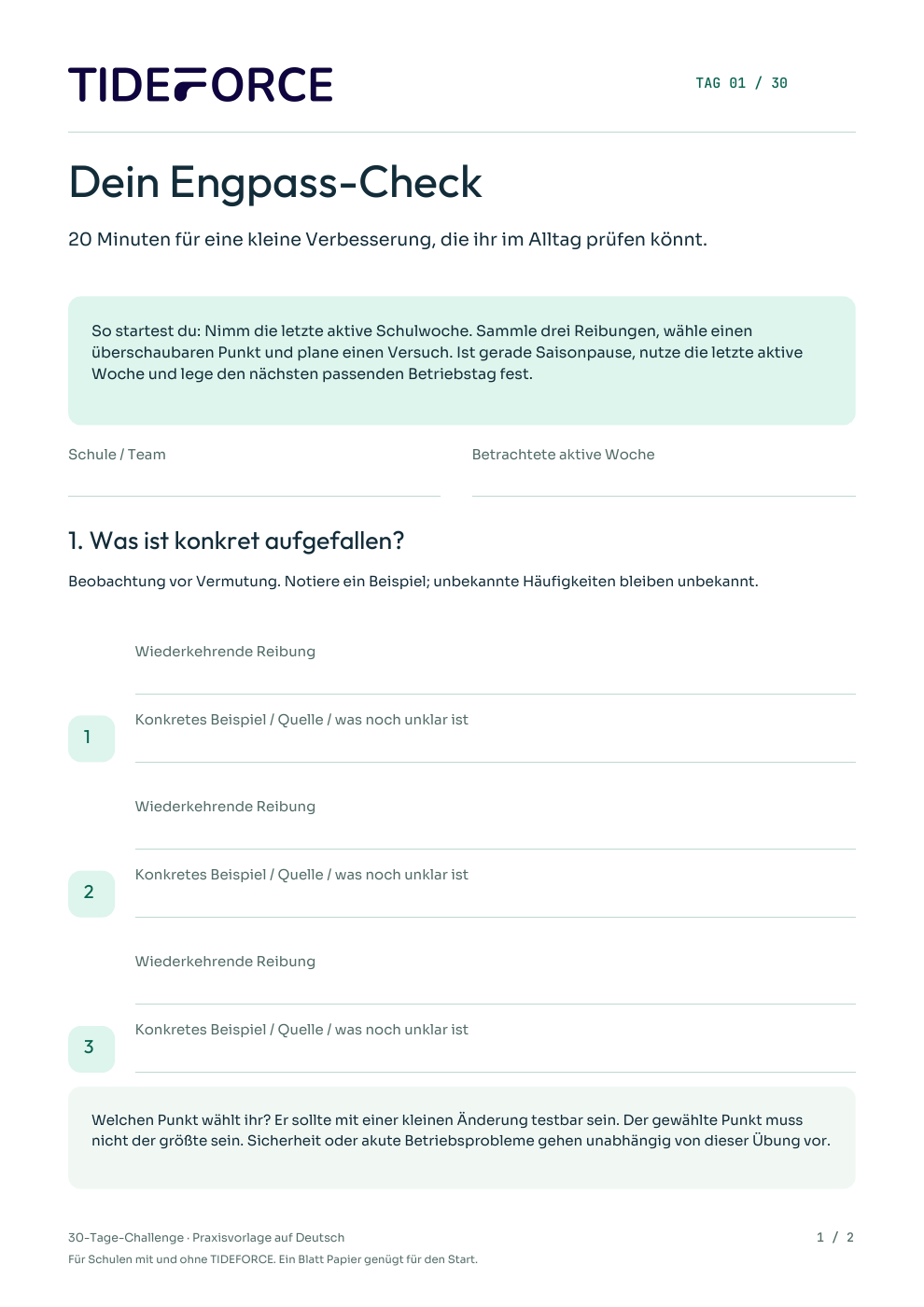
Your school bottleneck worksheet
Two printable pages for three observations, one small trial and a review. The worksheet is in German.
- Record three concrete points of friction from an active school week
- Plan one small trial with an owner and a review date
- Record observations and decide the next step after seven days
PDF · A4 · 2 pages · German
How does this work at your school?
Bring an everyday task from your school. We’ll show you how it could work in TIDEFORCE.
Request a demo →