
The final impression often happens between returning equipment and leaving the school. A short personal checkout connects four things: listening, clarifying the balance, suggesting a relevant next opportunity and respecting the guest’s contact preferences. Allow about five to ten minutes as a starting point; unresolved concerns need their own time.
Review bookings, feedback and payments before the conversation
Open the guest profile or your existing guest record. Review bookings, available session feedback, relevant team notes and payment status. A guest should not have to explain a previously reported difficulty from the beginning again. In TIDEFORCE, available information depends on modules, permissions and recorded data. Customer 360 can connect existing feedback reports; missing feedback is not positive feedback.
Ask about the stay and resolve outstanding concerns
Start openly: “How was your stay? What worked well, and what was missing?” Ask about instruction, organisation or equipment when helpful. If feedback already exists, refer to it gently: “You mentioned the meeting point. Did the new explanation help?” Leave space for criticism and record only relevant information.
An unresolved concern needs a responsible person and an agreed next step. A closing rating does not replace follow-through. Thank guests for critical feedback too; it may help improve the next stay.
Explain amounts paid, unpaid balances and credit
- Check extra sessions, extensions and other additions against the services actually recorded. Resolve discrepancies together.
- Account transparently for payments already received and existing credit. Explain the remaining balance and the appropriate payment route.
- If credit or a voucher remains, explain its value, validity and redemption under the agreed terms. Do not silently replace a possible refund with a voucher.
- Provide the appropriate receipt. If something remains open, record the amount or concern, responsible person and agreed next step.
Settling remaining payments at arrival often leaves only later additions or credit to review at departure. Always check the actual balance. A suitably configured TIDEFORCE checkout can show open amounts. A personal review still helps when a guest checks out at the terminal.
Invite an honest Google review without selecting only happy guests
Ask neutrally: “If you would like to, you can share your experience on Google. Here is the link for later.” Offer the same opportunity regardless of whether private feedback was positive, mixed or critical. The guest chooses the content, rating and timing. Avoid pressure at the desk or suggested positive wording.
Google permits requests for reviews of genuine experiences but prohibits incentives and selectively requesting positive reviews. Keep vouchers, discounts and free services separate from review requests. Genuine existing credit is handled independently of any review. Google’s review guidance and contribution policy.
If your configured feedback flow offers a Google link after an app or email response, test it with different ratings: the link must not appear only after favourable feedback. This guide does not assume an automatic Google invitation from TIDEFORCE. A neutral take-away card with a review link or QR code also works.
Offer marketing emails only through voluntary sign-up
Be specific: “Would you like occasional emails when course equipment is back in the shop, or when new camps and specials are available? It is optional, and you can unsubscribe easily at any time.” Name the actual content and channel. Promise infrequent messages only if that matches your practice.
A booking, download or friendly goodbye is not a newsletter subscription. Ask the guest to actively agree, for example through your subscription form with an option that is not preselected. Record the purpose, channel, consent wording, time and evidence of agreement. An office-set profile tick is not a substitute. Complete the configured confirmation process and make withdrawal easy. EDPB guidance on valid consent.
Saying no has no disadvantage. Operational information about an existing booking and optional marketing remain separate, as do the requests for a review and newsletter consent.
Discuss a relevant next course or future contact
When it fits the conversation, suggest a suitable next course, camp, side activity or specific shop offer. Connect it to what the guest enjoyed or wants to learn. Personal attention and voluntary contact can support repeat visits; they do not guarantee another booking.
Request the checkout guide by email. It works with TIDEFORCE or your existing records. For the first day, use the check-in and onboarding guide. Both PDFs are in German. Request each guide by entering your email address on its own page. This does not subscribe you to a newsletter.
Count unresolved bills at departure for one week
Track the share of balances clarified before departure: guests whose balance has been checked and jointly clarified, divided by all guests who completed a personal checkout that week. Legitimate credit can be clarified; a disputed or unclear charge is not. Use the checklist or guest records and note both counts plus common unresolved causes. This is a proposed manual measure, not a promised software metric.
If one cause repeats, improve an earlier step: remaining payments at arrival, timely recording of extra sessions or clearer credit explanations. Compare a similar period afterwards. Review participation and newsletter consent are not quality scores for the goodbye.
01Can we ask only happy guests for a Google review?
+
No. Offer the opportunity neutrally, regardless of previous feedback. An internal feedback flow must not restrict the Google link to positive responses.
02Can we give a voucher in exchange for a Google review?
+
No. Google prohibits incentives for reviews. Existing credit or an independently granted voucher remains separate from the request.
03Is a newsletter tick in the guest profile enough?
+
A tick alone does not establish voluntary consent. The guest must actively agree after receiving the relevant information; record purpose, channel, time and evidence.
04Do we need TIDEFORCE for this?
+
No. Use the checklist with your existing guest records, payment information and a short personal conversation.
Product and policy references checked on 22 October 2026. The routine, conversation templates and metric are editorial recommendations; TIDEFORCE views depend on the school’s setup.
More practical reading: session feedback throughout the stay and all guides and updates.
Practical knowledge for every watersports school
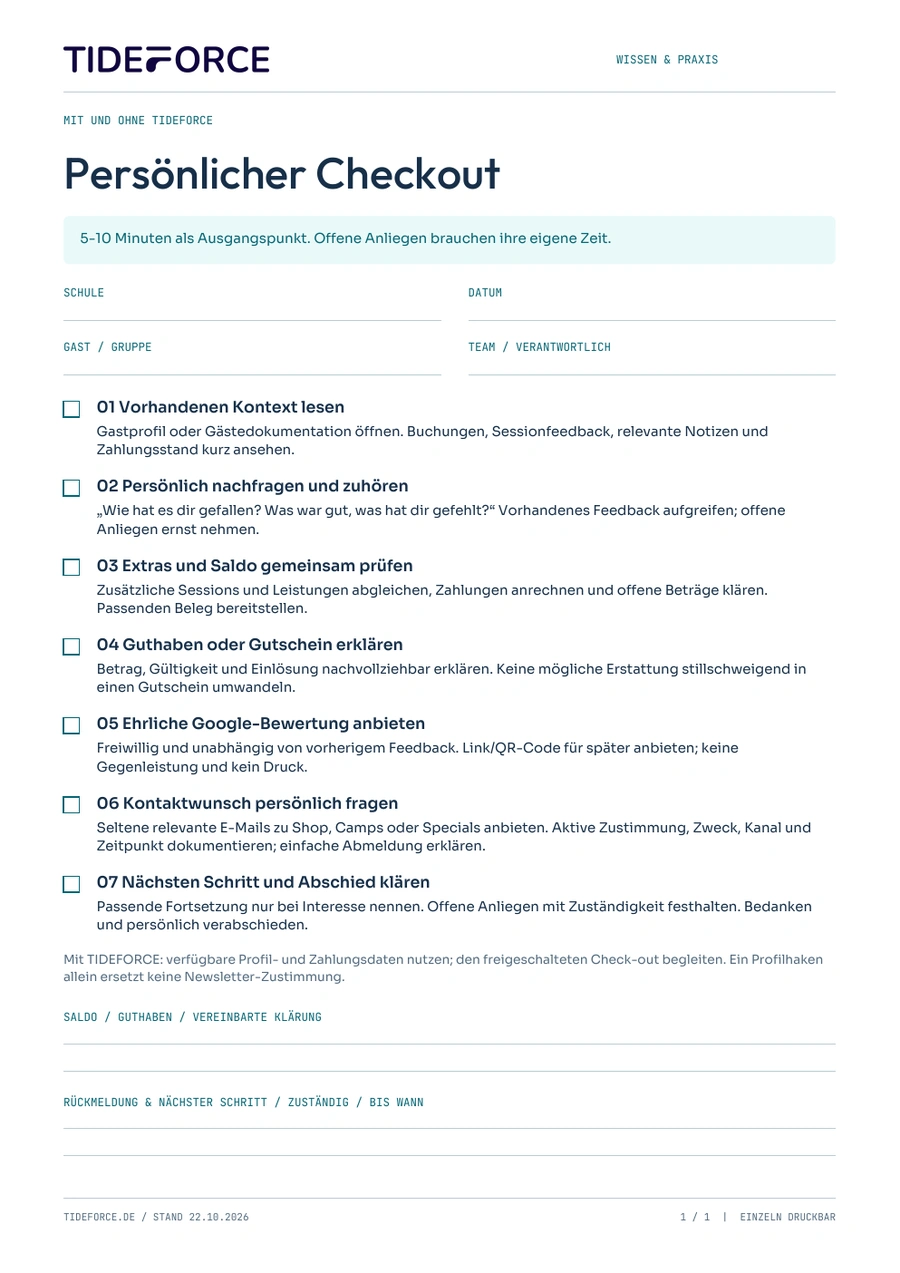
Give guests a personal goodbye
One printable checklist in German for the final conversation: resolve questions, check payments and discuss optional future contact.
- Read existing feedback and discuss unresolved concerns
- Compare extras, payments and credit
- Invite an honest review and clarify contact preferences
PDF · A4 · 1 page · German
How does this work at your school?
Bring an everyday task from your school. We’ll show you how it could work in TIDEFORCE.
Request a demo →